
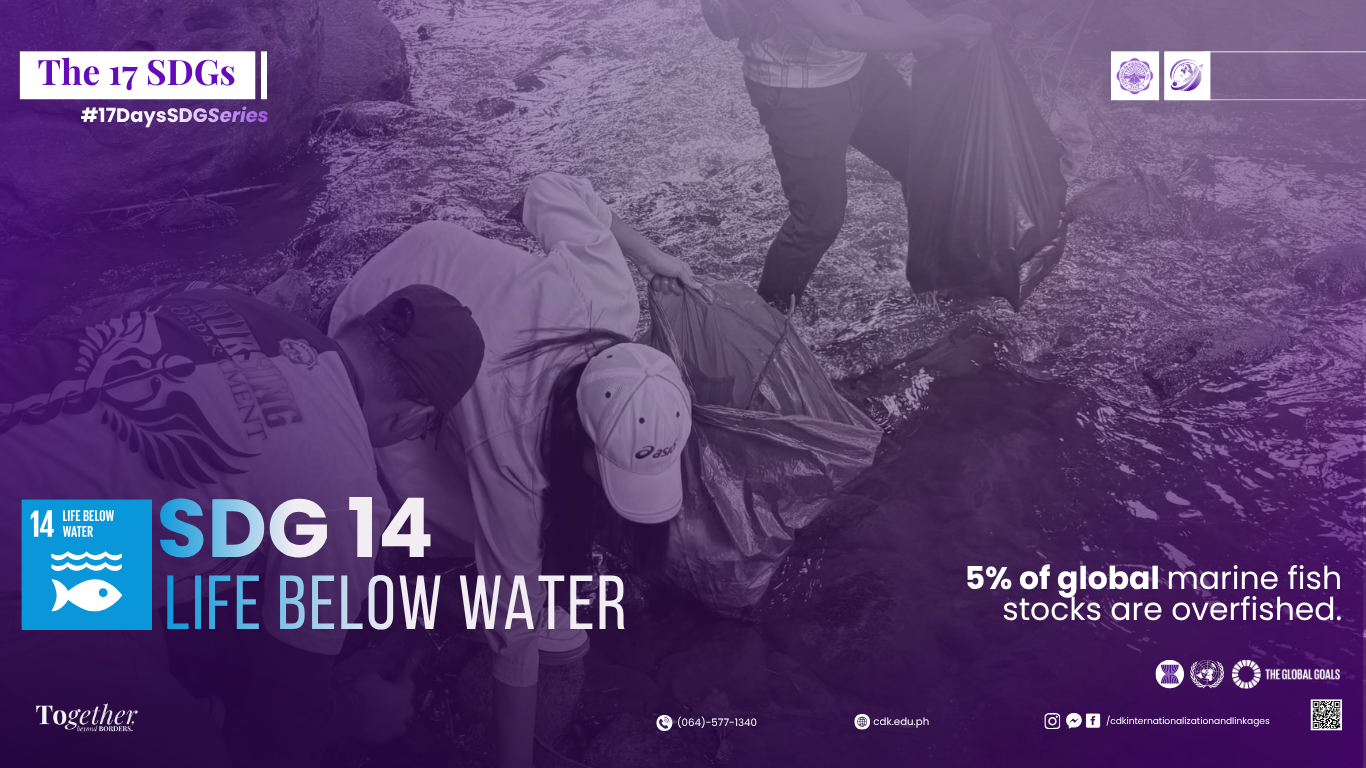
Conserve and sustainably use the oceans, seas, and marine resources for sustainable development.
A river that flows. A lake that reflects. An ocean that stretches endlessly. But beneath the surface, life is changing.
Before the world wakes, water is already moving. A fisherman casts his net into waters that once seemed endless, only to find fewer fish than fed his family for years. A child walks along a river filled with plastic that was once carried by the current. In the lake, the water becomes cloudier, and the life beneath it slowly disappears. We forget: the water that gives us life is struggling to survive.
We often think pollution ends when the trash disappears from our sight. What we leave on the ground can find its way into a river. What enters a river can reach a lake. What reaches the lake can eventually find its way to the ocean. And beneath the surface, life pays the price.
The world’s oceans are under unprecedented stress. In 2025, global ocean heat content reached its highest level on record, gaining 23 zettajoules of energy—the ninth consecutive year of record-breaking warmth. Ocean surface temperatures in 2025 ranked as the third warmest year in the instrumental record, remaining about 0.5°C above the 1981–2010 average.
Marine ecosystems are collapsing under chronic warming. Research shows that fish populations decline by 7.2% for every 0.1°C of ocean warming per decade, with biomass reductions of up to 19.8% within a single year during extreme heat events. In 2026, as global temperatures temporarily exceeded 1.5°C above pre-industrial levels, 98% of documented ecological impacts were associated with unusually warm sea temperatures.
Ocean acidification continues unchecked. The average ocean pH has decreased from 8.1 in 1985 to 8.04 in 2023, a rate of -0.017 pH units per decade. This acidification threatens shellfish, corals, and the entire marine food web. Meanwhile, 35.5% of marine fish stocks were overfished in 2021, and an estimated 52.1 million metric tons of plastic waste enters the ocean annually, impacting thousands of species.
In the Philippines, a global hotspot of marine biodiversity, coral reefs face mounting threats from warming, pollution, and destructive fishing practices. Marine heatwaves in the South-West Pacific region disrupted ecosystems and fisheries throughout 2025, with 2025 ranking as the second warmest year on record for the region.
The question is no longer whether the water can survive without us. The question is whether we can survive without it. Without ocean protection, marine life collapses. Without sustainable fishing, coastal communities starve. With urgent action, oceans can recover. Reducing emissions, protecting marine habitats, ending overfishing, and cutting plastic pollution are not optional—they are survival. At Colegio de Kidapawan, SDG 14 calls us to defend the blue heart of our planet, not simply about protecting the ocean. It is about protecting every body of water that connects us to life.
What can we do today?
- Reduce single-use plastics and support ocean cleanup initiatives
- Choose sustainably sourced seafood and support small-scale fishers
- Advocate for marine protected areas and coral reef conservation
- Reduce carbon footprint to limit ocean warming and acidification
- Support policies and activities that address plastic pollution and overfishing
There is no life without blue.
𝑻𝒐𝒈𝒆𝒕𝒉𝒆𝒓, 𝒃𝒆𝒚𝒐𝒏𝒅 𝒃𝒐𝒓𝒅𝒆𝒓𝒔.
Sources: UN SDG Report 2025 (Goal 14); WMO; Copernicus on ocean warming and acidification[bbc][sciencedaily][theclimateadaptationcenter] The Guardian; Phys.org; TIME on marine heatwaves and fish population decline; Al Jazeera; Marine Insight; ScienceDaily on 2025–2026 ocean temperature records[sciencedaily]